BabyAGI Review 2026: Features, Workflow, Pricing & Real-World Use Cases
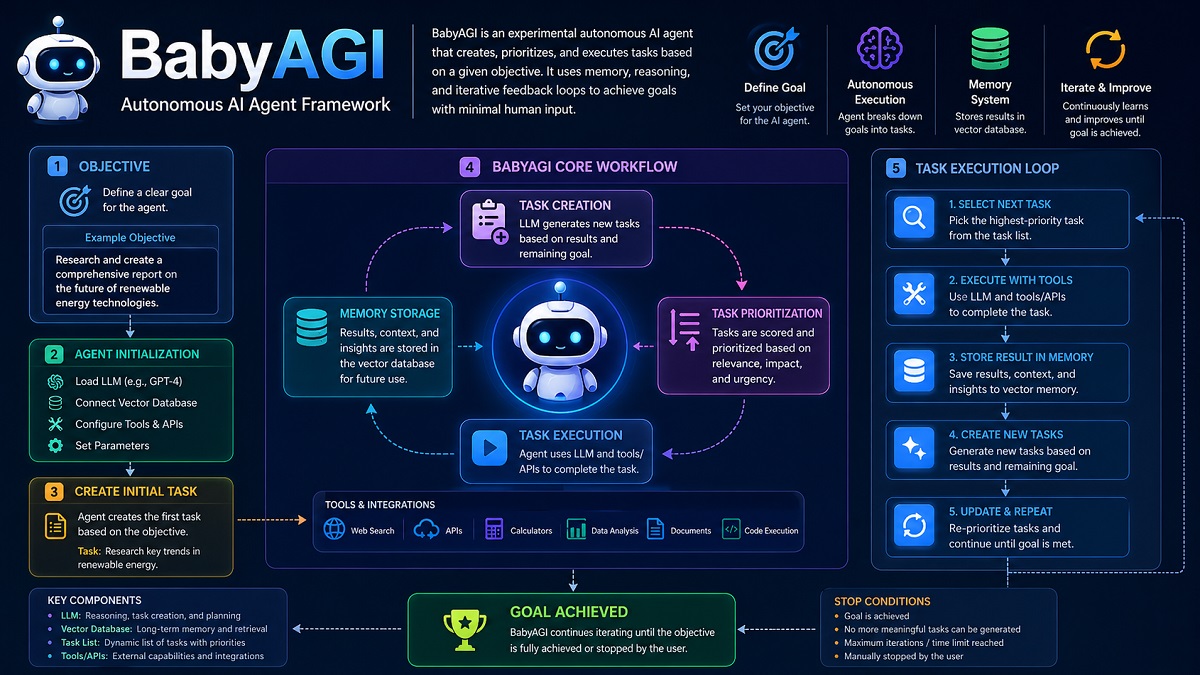
BabyAGI Overview
BabyAGI is an experimental open-source autonomous AI agent framework designed to simulate task management and self-improving workflows using large language models. Inspired by early autonomous AI concepts, BabyAGI can generate, prioritize, and execute tasks based on a defined objective, making it a powerful demonstration of how AI systems can operate with minimal human intervention.
The core idea behind BabyAGI is simple yet powerful: you provide a goal, and the system continuously creates new tasks, evaluates their importance, and processes them in a loop. It maintains a task list, stores results, and uses memory to improve future outputs. This makes it particularly useful for developers and researchers exploring automation, AI agents, and recursive task execution models.
Although BabyAGI is not a polished commercial product, it has gained significant attention in the AI community for showcasing the potential of autonomous agents. It integrates with tools like vector databases and APIs to enhance memory and context handling. While still experimental, BabyAGI represents an important step toward more advanced AI systems capable of independent decision-making and long-term task planning.
BabyAGI: Quick Verdict
BabyAGI is a fascinating proof-of-concept that demonstrates the future potential of autonomous AI agents. It excels in showcasing how AI can break down goals into tasks, prioritize them, and execute workflows with minimal human input.
However, it remains an experimental project rather than a production-ready tool. While powerful for developers and AI enthusiasts, it may feel limited or complex for general users. Overall, BabyAGI is best viewed as an innovative glimpse into the future of AI automation rather than a fully mature solution.
Pros of BabyAGI
- Autonomous task creation and execution based on a defined goal
- Demonstrates real-world potential of AI agents and automation workflows
- Open-source and highly customizable for developers
- Uses memory (via vector databases) to improve task continuity
- Lightweight framework that’s easy to experiment with
- Encourages innovation in AI research and agent-based systems
- Integrates with APIs and external tools for extended functionality
- Great learning resource for understanding autonomous AI concepts
Cons of BabyAGI
- Not a production-ready tool; primarily experimental
- Requires technical knowledge to set up and use effectively
- Limited real-world reliability for complex or long tasks
- Can generate repetitive or low-quality task outputs
- Depends heavily on external APIs and LLM performance
- Lacks a user-friendly interface for non-developers
- May incur costs when integrated with paid AI services
- Memory handling can be inconsistent without proper configuration
What is BabyAGI?
BabyAGI is an open-source experimental AI framework that simulates autonomous task management using large language models. It allows users to define a goal, after which the system automatically generates, prioritizes, and executes tasks in a continuous loop. By leveraging memory (often through vector databases), BabyAGI can store past results and use them to improve future decisions, creating a dynamic and self-adjusting workflow.
While powerful as a concept, BabyAGI is not a true Artificial General Intelligence system but rather a prototype that demonstrates how AI agents can operate independently with minimal human input. It is mainly used by developers and researchers to explore automation, AI workflows, and the future potential of self-directed intelligent systems.
BabyAGI Workflow
BabyAGI follows a continuous task-driven loop where an AI agent autonomously creates, prioritizes, and executes tasks based on a defined objective. The system relies on memory, iteration, and dynamic task management to improve results over time.
1. Define the Objective
The workflow begins with a clear goal provided by the user. This objective acts as the foundation
for all tasks the AI generates and executes.
2. Create Initial Task
BabyAGI generates a starting task based on the objective. This is usually a simple, actionable step
that helps kickstart the process.
3. Execute Task
The system processes the task using an LLM (like GPT). It gathers relevant data, performs reasoning,
and produces an output.
4. Store Results in Memory
The output is saved into a vector database (such as Pinecone or FAISS), allowing the agent to recall
past actions and build contextual understanding.
5. Generate New Tasks
Based on the result, BabyAGI creates new tasks that move closer to achieving the main objective.
6. Prioritize Tasks
The system reorders tasks dynamically, ensuring the most important or relevant ones are executed first.
7. Repeat the Loop
The agent continuously cycles through execution, memory storage, and task generation until the
objective is completed or stopped by the user.
This iterative loop makes BabyAGI powerful for automation, research, and multi-step problem solving, as it mimics a simplified autonomous thinking process.
Key Features of BabyAGI
BabyAGI is designed as a lightweight autonomous AI agent framework that can think, plan, and execute tasks iteratively. Below are its core features that make it powerful for automation and experimentation.
- Autonomous Task Management: Automatically creates, manages, and executes tasks based on a single objective without constant human input.
- Iterative Task Loop: Runs a continuous cycle of task execution, creation, and prioritization to refine results over time.
- Dynamic Task Creation: Generates new tasks based on previous outputs, ensuring continuous progress toward the goal.
- Task Prioritization: Reorders tasks intelligently to focus on the most relevant and impactful actions first.
- Memory with Vector Database: Stores task results using embeddings (e.g., Pinecone or FAISS) to maintain context and recall past actions.
- LLM-Powered Reasoning: Uses large language models (like GPT) for decision-making, task generation, and natural language understanding.
- Dynamic Task Queue: Maintains a real-time queue of tasks that updates as new tasks are created and completed.
- Modular Agent Architecture: Includes separate agents for execution, task creation, and prioritization working together.
- Continuous Learning Loop: Improves performance by using results from previous tasks to guide future actions.
- Lightweight & Open-Source: Simple and flexible framework ideal for learning, prototyping, and building autonomous AI systems.
Together, these features enable BabyAGI to simulate a basic autonomous workflow, making it a popular choice for developers exploring AI agents.
BabyAGI: Performance and Ease of Use
BabyAGI delivers a unique approach to autonomous task execution, but its performance and usability depend heavily on how it is configured and deployed. While powerful in concept, it is best suited for users with some technical background.
Performance:
BabyAGI performs well for structured, multi-step tasks such as research, planning,
and workflow automation. Its iterative loop allows it to refine outputs over time,
making it effective for tasks that benefit from continuous improvement. However,
performance can vary depending on the underlying language model, API limits, and
the quality of the objective provided. It may occasionally generate redundant or
less relevant tasks, especially in longer task chains.
Speed & Efficiency:
Since BabyAGI relies on repeated API calls and memory retrieval, execution can be
slower compared to traditional tools. The use of vector databases adds context but
also introduces slight latency. Optimization and proper configuration can improve
efficiency significantly.
Ease of Use:
BabyAGI is not designed as a plug-and-play tool. It requires setup, including API
keys, environment configuration, and sometimes integration with databases like
Pinecone or FAISS. This makes it more suitable for developers rather than beginners.
User Experience:
The interface is minimal and mostly code-based, lacking a polished UI. Users interact
with the system through scripts or command-line environments, which may feel complex
for non-technical users but offers flexibility for customization.
Learning Curve:
There is a moderate to steep learning curve, especially for those unfamiliar with
AI agents, APIs, or vector databases. However, once understood, it becomes a powerful
experimentation tool for building autonomous workflows.
Overall, BabyAGI offers strong performance for experimental and developer-focused use cases, but its usability is limited by its technical setup and lack of a beginner-friendly interface.
Key Specifications of BabyAGI
BabyAGI is a lightweight autonomous AI agent framework designed for task-driven workflows. Below are its core technical specifications and system components.
| Category | Details |
|---|---|
| Type | Autonomous AI Task Management System |
| Core Function | Task creation, prioritization, and execution loop |
| AI Model | Large Language Models (e.g., GPT-4 or similar) |
| Memory System | Vector database (Pinecone, FAISS) |
| Architecture | Multi-agent system (execution, creation, prioritization) |
| Workflow Type | Iterative feedback loop |
| Input Method | User-defined objective or goal |
| Output | Task results, generated insights, updated task lists |
| Interface | Command-line / script-based (no native GUI) |
| Deployment | Local environment or cloud-based setup |
| Integration | Supports APIs, databases, and external tools |
| Open Source | Yes (community-driven project) |
| Best Use Cases | Automation, research, AI agent experimentation |
These specifications highlight BabyAGI’s focus on flexibility and experimentation, making it ideal for developers exploring autonomous AI workflows rather than traditional end-users.
BabyAGI Pricing
BabyAGI is an open-source autonomous AI framework, which means its core version is completely free to use. However, the overall cost depends on how you deploy and use it, especially when integrating with external APIs like OpenAI.
Free (Open-Source) $0
The base version of BabyAGI is available on GitHub and can be used without any licensing fees.
- Full access to source code
- Customizable task execution system
- Self-hosting capability
- Community-driven updates
API Usage Costs Pay-as-you-go
While BabyAGI itself is free, it relies on AI models like OpenAI's GPT APIs, which are billed separately.
- Charges based on tokens (input + output)
- Costs vary depending on model (GPT-4, GPT-3.5, etc.)
- Higher usage = higher costs
- Requires API key integration
Hosting & Infrastructure Variable
If you deploy BabyAGI on your own server or cloud platform, you may incur additional costs.
- Cloud hosting (AWS, VPS, etc.)
- Storage and database usage
- Scaling costs for heavy workloads
Custom Development (Optional) Varies
Businesses or advanced users may invest in custom development or integrations.
- Automation workflows
- API integrations
- UI dashboards
- Enterprise-level customization
Summary: BabyAGI is free to start, but real-world usage costs depend on API consumption and infrastructure. For light experimentation, costs remain minimal, while production use can scale depending on demand.
Who Should Use BabyAGI?
BabyAGI is best suited for users who want to explore autonomous AI agents, experiment with task automation, and understand how AI can break down complex goals into smaller steps.
- Developers & Programmers: Ideal for those comfortable with Python and APIs who want to build or experiment with autonomous AI workflows and task-based agents.
- AI Researchers & Enthusiasts: Great for studying how AI agents create, prioritize, and execute tasks using LLMs and vector databases. It’s often used as a sandbox for experimentation rather than production.
- Startup Builders & Hackers: Useful for prototyping automation ideas such as content generation, research bots, or workflow automation without building everything from scratch.
- Automation Enthusiasts: Suitable for users interested in automating multi-step tasks where the AI can plan and iterate toward a goal independently.
- Students & Learners: A good learning tool for understanding emerging concepts like autonomous agents, task chaining, and AI-driven decision-making.
- Experimenters & Early Adopters: Since BabyAGI is still experimental and not production-ready, it’s best for users who enjoy testing cutting-edge AI tools and exploring their limitations.
Who Should Avoid It? Beginners with no coding experience or businesses looking for a stable, production-ready AI solution may find BabyAGI challenging, as it requires technical setup and is still evolving.
Alternatives to BabyAGI
While BabyAGI is a lightweight framework for autonomous task execution, several powerful alternatives offer more features, better usability, or enterprise-level scalability depending on your needs.
| Tool | Best For | Key Highlights |
|---|---|---|
| AutoGPT | Fully autonomous AI workflows | Advanced planning, web browsing, file handling, and multi-step reasoning capabilities |
| AgentGPT | No-code users & beginners | Browser-based AI agent builder with simple UI and ready-to-use templates |
| LangChain | Custom AI app development | Flexible framework for chaining LLMs, tools, and data sources into workflows |
| Microsoft AutoGen | Enterprise multi-agent systems | Supports collaborative AI agents that communicate and solve complex problems together |
| CrewAI | Team-based AI workflows | Creates multiple AI “roles” working together like a team to complete tasks |
| LlamaIndex | Data-driven AI agents | Specialized in connecting LLMs with external data for retrieval-based workflows |
| SuperAGI | Production-ready agent systems | Includes dashboards, monitoring, and scalable agent deployment tools |
Summary: If you want simplicity, BabyAGI is great for learning. For more advanced automation, tools like AutoGPT or AutoGen offer deeper capabilities, while AgentGPT is ideal for beginners who prefer a no-code experience.
BabyAGI vs Alternatives: Comparison
Choosing the right autonomous AI framework depends on your technical skills, use case, and desired level of control. Below is a side-by-side comparison of BabyAGI and its popular alternatives.
| Feature | BabyAGI | AutoGPT | AgentGPT | LangChain | AutoGen |
|---|---|---|---|---|---|
| Ease of Use | Moderate (requires setup) | Complex | Very Easy (no-code) | Moderate | Advanced |
| Technical Skill Required | Medium | High | Low | Medium–High | High |
| Automation Capability | Basic task loop | Advanced autonomy | Limited | Highly customizable | Multi-agent collaboration |
| Customization | High (open-source) | High | Low | Very High | Very High |
| User Interface | Minimal / CLI | CLI-based | Web-based UI | Developer-focused | Code-based |
| Best Use Case | Learning & prototyping | Full automation agents | Quick AI tasks | AI app development | Enterprise AI systems |
| Production Ready | ❌ No | ⚠️ Experimental | ✅ Yes (basic) | ✅ Yes | ✅ Yes |
| Pricing | Free (API costs apply) | Free (API costs apply) | Freemium | Free + paid ecosystem | Free (enterprise cost varies) |
Final Insight: BabyAGI is best for understanding how autonomous agents work at a fundamental level. If you need more power, AutoGPT or AutoGen offer advanced automation, while AgentGPT is ideal for beginners and LangChain excels in building scalable AI applications.
Final Verdict on BabyAGI
BabyAGI stands out as one of the most influential early experiments in autonomous AI agents. Its simple task-loop architecture makes it an excellent starting point for understanding how AI can break down goals, prioritize tasks, and iterate toward results without constant human input.
However, it’s important to set realistic expectations. BabyAGI is not a polished, production-ready tool—it’s a lightweight framework designed primarily for learning, experimentation, and prototyping. Compared to more advanced alternatives, it lacks built-in interfaces, scalability features, and robust error handling.
For developers, researchers, and AI enthusiasts, BabyAGI offers valuable insights into the future of automation and agent-based systems. For businesses or non-technical users, more user-friendly and scalable solutions may be a better fit.
Overall Rating:
Bottom Line: If you want to explore how autonomous AI agents work under the hood, BabyAGI is absolutely worth trying. But if you're looking for a stable, feature-rich solution for real-world deployment, you’ll likely need to look beyond it.
Try BabyAGI Now