AutoGen Review 2026 – Features, Pricing, Pros & Cons of Multi-Agent AI Framework
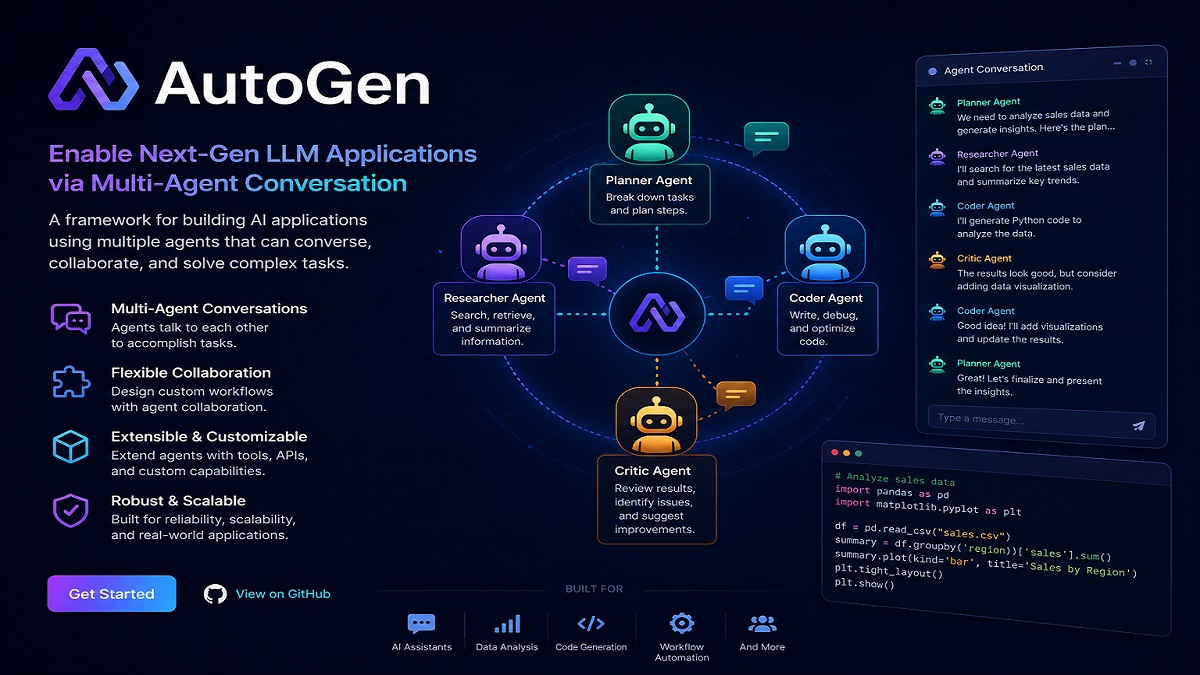
AutoGen Overview
AutoGen is an advanced multi-agent AI framework developed by Microsoft that enables developers to build applications where multiple AI agents collaborate, communicate, and solve complex tasks autonomously. Instead of relying on a single AI model, AutoGen allows different agents—such as planners, executors, and reviewers—to work together in a structured workflow.
The platform is designed to simplify the development of AI-driven systems by orchestrating conversations between agents powered by large language models like GPT. These agents can generate code, debug errors, analyze data, and even interact with external tools, making AutoGen highly versatile for real-world automation tasks.
One of the standout features of AutoGen is its ability to combine human input with autonomous AI interactions. Developers can step in when needed or allow agents to operate independently, offering a flexible balance between control and automation. This makes it ideal for use cases such as software development, research assistance, workflow automation, and complex problem-solving.
Overall, AutoGen represents a major step forward in the evolution of AI systems, shifting from single-model interactions to collaborative, multi-agent intelligence that can handle more sophisticated and dynamic tasks efficiently.
AutoGen: Quick Verdict
AutoGen, developed by Microsoft, is a powerful multi-agent AI framework designed for building intelligent, collaborative systems. It stands out for its ability to orchestrate multiple AI agents that can communicate, plan, and execute tasks autonomously.
The platform is best suited for developers, researchers, and advanced users who want to create complex AI workflows such as automated coding, data analysis, and task automation. While highly flexible and innovative, AutoGen does come with a learning curve, especially for beginners unfamiliar with agent-based architectures.
Verdict: If you're looking to build next-generation AI applications with collaborative agents, AutoGen is one of the most powerful tools available today. However, casual users may find simpler AI tools easier to start with.
Pros of AutoGen
- Supports multi-agent collaboration for complex task automation
- Highly flexible and customizable for different workflows
- Integrates well with large language models like GPT
- Enables autonomous task execution with minimal human input
- Great for developers, researchers, and AI experimentation
- Open-source and backed by Microsoft
Cons of AutoGen
- Steep learning curve for beginners
- Requires coding knowledge to fully utilize
- Setup and configuration can be time-consuming
- Performance depends on underlying AI models and APIs
- Not ideal for simple or casual use cases
- Debugging multi-agent workflows can be complex
What is AutoGen?
AutoGen is a multi-agent AI framework developed by Microsoft that enables the creation of intelligent systems where multiple AI agents collaborate to complete tasks. Instead of relying on a single AI model, AutoGen allows different agents—each with specific roles like planning, executing, or reviewing—to communicate and work together in a coordinated workflow.
Built on top of large language models such as GPT, AutoGen can handle complex processes like code generation, debugging, data analysis, and automation. These agents can interact with each other, external tools, and even human users, making the system highly dynamic and adaptable.
What makes AutoGen unique is its ability to combine human guidance with autonomous AI interactions. Developers can choose to fully automate workflows or step in at any stage, giving them flexibility and control over how tasks are executed.
In simple terms, AutoGen transforms AI from a single assistant into a team of collaborating agents, capable of solving more advanced and real-world problems efficiently.
AutoGen Workflow
AutoGen operates through a structured multi-agent workflow where different AI agents collaborate to complete tasks efficiently. Each agent is assigned a specific role, and they communicate with one another to plan, execute, and refine outcomes.
The process typically begins with a task definition, where the user provides a goal or problem statement. A planning agent then analyzes the request and breaks it down into smaller, manageable steps.
Next, execution agents take over to perform actions such as generating code, retrieving data, or interacting with external tools. These agents can work iteratively, improving results based on feedback from other agents.
A review or critic agent evaluates the output, checks for errors, and suggests improvements. If needed, the workflow loops back for refinement until the desired result is achieved.
Throughout the process, human-in-the-loop interaction can be included, allowing users to guide, approve, or modify steps. This ensures both flexibility and reliability in complex scenarios.
In essence, AutoGen’s workflow transforms a single AI interaction into a collaborative system where multiple agents continuously communicate and optimize results, making it ideal for advanced automation and problem-solving tasks.
Key Features of AutoGen
AutoGen offers a powerful set of features that make it one of the most advanced multi-agent AI frameworks available for building autonomous and collaborative AI systems.
- Multi-Agent Collaboration: Enables multiple AI agents to work together, each handling specific roles like planning, execution, and review.
- Conversational Agent Framework: Agents communicate through structured conversations, allowing dynamic problem-solving and iterative improvements.
- Human-in-the-Loop Support: Allows users to intervene, guide, or approve tasks at any stage for better control and accuracy.
- Code Generation & Execution: Supports automated coding, debugging, and execution of scripts within the workflow.
- Tool & API Integration: Easily integrates with external tools, APIs, and data sources to extend functionality.
- Customizable Agent Roles: Developers can design agents with specific behaviors, goals, and interaction patterns.
- Scalable Architecture: Suitable for simple automation tasks as well as complex, enterprise-level AI systems.
- LLM Compatibility: Works with large language models like GPT, making it adaptable to different AI ecosystems.
- Iterative Problem Solving: Agents continuously refine outputs through feedback loops, improving accuracy over time.
- Open-Source Flexibility: Backed by Microsoft, offering transparency and extensibility for developers.
AutoGen: Performance and Ease of Use
AutoGen delivers strong performance when it comes to handling complex, multi-step tasks. Its multi-agent architecture allows different AI agents to collaborate efficiently, resulting in more accurate and refined outputs compared to single-model systems. Tasks such as code generation, debugging, and data analysis benefit significantly from this iterative approach, where agents continuously improve results through feedback loops.
In terms of scalability, AutoGen performs well across a wide range of use cases—from simple automation to advanced AI workflows. However, overall performance can vary depending on the underlying language models (such as GPT) and API configurations, which may impact speed, cost, and reliability.
When it comes to ease of use, AutoGen is more suited for developers and technically experienced users. Setting up agents, defining workflows, and managing interactions requires a basic understanding of programming and AI concepts. Beginners may find the initial learning curve challenging.
That said, once configured, AutoGen offers a highly flexible and powerful environment for automation. Its ability to combine human input with autonomous AI execution makes it a valuable tool for users who need both control and efficiency in complex projects.
Overall: Excellent performance for advanced tasks, but best suited for users comfortable with technical setup and customization.
Key Specifications of AutoGen
AutoGen is designed as a flexible, developer-focused AI framework with powerful capabilities for building multi-agent systems. Below are its core technical specifications and characteristics.
- Developer: Microsoft
- Type: Multi-agent AI framework
- Deployment: Local environment or cloud-based setup
- Supported Models: GPT and other large language models (LLMs)
- Programming Language: Primarily Python
- Architecture: Multi-agent conversational system
- Core Functionality: Task automation, code generation, data analysis, workflow orchestration
- Integration: APIs, external tools, plugins, and custom scripts
- Human Interaction: Human-in-the-loop support
- Scalability: Suitable for both small projects and enterprise-level applications
- Customization: Highly customizable agent roles and workflows
- License: Open-source
- Use Cases: Software development, research automation, AI agents, task orchestration
AutoGen Pricing
AutoGen follows a completely free and open-source pricing model, making it highly accessible for developers, researchers, and businesses. The framework itself is available at no cost and can be used without any licensing fees.
Core Framework Free
The AutoGen framework, including its core features and tools like AutoGen Studio, is freely available on GitHub. There are no subscriptions, per-user fees, or hidden charges from Microsoft for using the framework itself.
API & Model Costs Pay-as-you-go
While AutoGen is free, it typically relies on external AI models such as GPT, Claude, or other LLMs. These services charge based on usage (usually per token or request), meaning your overall cost depends on how much you use these APIs.
- GPT models – usage-based pricing (per token)
- Azure OpenAI – enterprise pricing
- Local models – free (runs on your own hardware)
Infrastructure Costs Variable
If you deploy AutoGen applications in production, you may incur additional costs for cloud hosting, servers, or storage depending on your setup. These costs are separate from AutoGen itself.
Overall: AutoGen is free to use, but real-world costs come from the AI models and infrastructure you choose. This flexible pricing makes it ideal for both experimentation and scalable production systems.
Who Should Use AutoGen?
AutoGen is a powerful multi-agent AI framework best suited for users who want to build advanced, automated, and collaborative AI systems. It is particularly valuable for those comfortable working with code and AI workflows.
- Developers & Engineers: Ideal for building complex AI applications, automation pipelines, and agent-based systems.
- AI Researchers: Useful for experimenting with multi-agent collaboration, LLM behavior, and advanced problem-solving techniques.
- Startups & Tech Teams: Great for creating scalable AI-powered products, assistants, and automation tools.
- Data Scientists & Analysts: Helpful for automating data analysis, report generation, and iterative workflows.
- Automation Enthusiasts: Perfect for users looking to automate repetitive or multi-step tasks using intelligent agents.
- Advanced AI Users: Best for those who understand APIs, LLMs, and scripting, as it requires some technical setup and customization.
Not ideal for: Beginners or casual users who prefer simple, no-code AI tools, as AutoGen involves a learning curve and technical configuration.
Alternatives to AutoGen
While AutoGen is a powerful multi-agent AI framework, several alternatives offer different approaches to building AI agents—ranging from developer-focused frameworks to no-code platforms. Choosing the right one depends on your technical skills, project complexity, and deployment needs.
| Tool | Best For | Key Features | Pricing |
|---|---|---|---|
| CrewAI | Structured multi-agent workflows | Role-based agents, task pipelines, easy setup | Free + Paid plans |
| LangGraph | Stateful agent workflows | Graph-based orchestration, checkpointing, control flow | Free (open-source) |
| LlamaIndex | Data-heavy AI applications | RAG pipelines, document indexing, knowledge graphs | Free + Paid plans |
| ZenML | Production-grade pipelines | Workflow orchestration, experiment tracking, reproducibility | Free + Paid plans |
| Dust | No-code AI agents | UI-based agent builder, integrations with Slack & Notion | Subscription-based |
| Knolli | No-code AI copilots | Workflow automation, memory, monetization tools | Paid plans |
| Haystack | Search & RAG systems | Modular pipelines, NLP tools, scalable architecture | Free + Enterprise |
| Smolagents | Lightweight agent development | Minimal design, Hugging Face integration | Free |
Many of these alternatives focus on specific strengths—such as LangGraph for stateful workflows or CrewAI for simpler role-based collaboration—while others like Dust and Knolli cater to users who prefer no-code solutions.
Overall: If you want flexibility and deep customization, developer-focused tools like LangGraph or ZenML are strong choices. For ease of use, no-code platforms provide a faster way to build AI agents without heavy technical setup.
AutoGen vs Alternatives: Comparison
AutoGen competes with several leading multi-agent AI frameworks, each built around a different philosophy—conversation, roles, or workflow graphs. Understanding these differences is key to choosing the right tool for your project.
| Feature | AutoGen | LangGraph | CrewAI |
|---|---|---|---|
| Core Approach | Conversation-based multi-agent system | Graph-based workflow orchestration | Role-based agent collaboration |
| Best Use Case | Dynamic, conversational AI tasks | Complex, stateful workflows | Structured task pipelines |
| Ease of Use | Moderate | Steep learning curve | Very beginner-friendly |
| Flexibility | High | Very high | Moderate |
| Workflow Control | Message-driven control | Explicit graph/state control | Task & role-based flow |
| Human-in-the-loop | Strong support | Native interrupt support | Limited / custom setup |
| Scalability | Good | Excellent (enterprise-ready) | Good (best for linear workflows) |
| Time to Build | Fast | Medium to slow | Fastest |
| Production Readiness | Moderate | High | Moderate |
Key Insight: Each framework excels in a different area. AutoGen is best for conversational and flexible agent systems, LangGraph is ideal for complex, production-grade workflows with full control, and CrewAI is perfect for quickly building structured, role-based automation pipelines.
Final Take: Choose AutoGen if your application relies on dynamic interactions between agents, go with LangGraph for enterprise-level orchestration, and pick CrewAI for rapid prototyping and simpler workflows.
Final Verdict on AutoGen
AutoGen stands out as one of the most innovative frameworks in the AI space, bringing multi-agent collaboration into practical, real-world use. Its ability to let AI agents communicate, plan, and execute tasks together makes it far more powerful than traditional single-model tools.
The framework is especially valuable for developers and teams building complex AI systems such as automated coding assistants, research tools, and workflow automation platforms. Its flexibility, open-source nature, and strong backing from Microsoft make it a future-ready solution for advanced AI development.
However, AutoGen is not designed for everyone. Beginners or non-technical users may find the setup and learning curve challenging compared to simpler, no-code AI tools. It requires a solid understanding of APIs, programming, and AI concepts to unlock its full potential.
Final Rating: ⭐⭐⭐⭐☆ (4.5/5)
Bottom Line: If you want to build powerful, collaborative AI systems with high flexibility and control, AutoGen is an excellent choice. But if you're looking for a quick, beginner-friendly solution, you may want to explore simpler alternatives.
Try AutoGen Now