ZenML Review 2026 – Features, Pricing, Pros & Cons
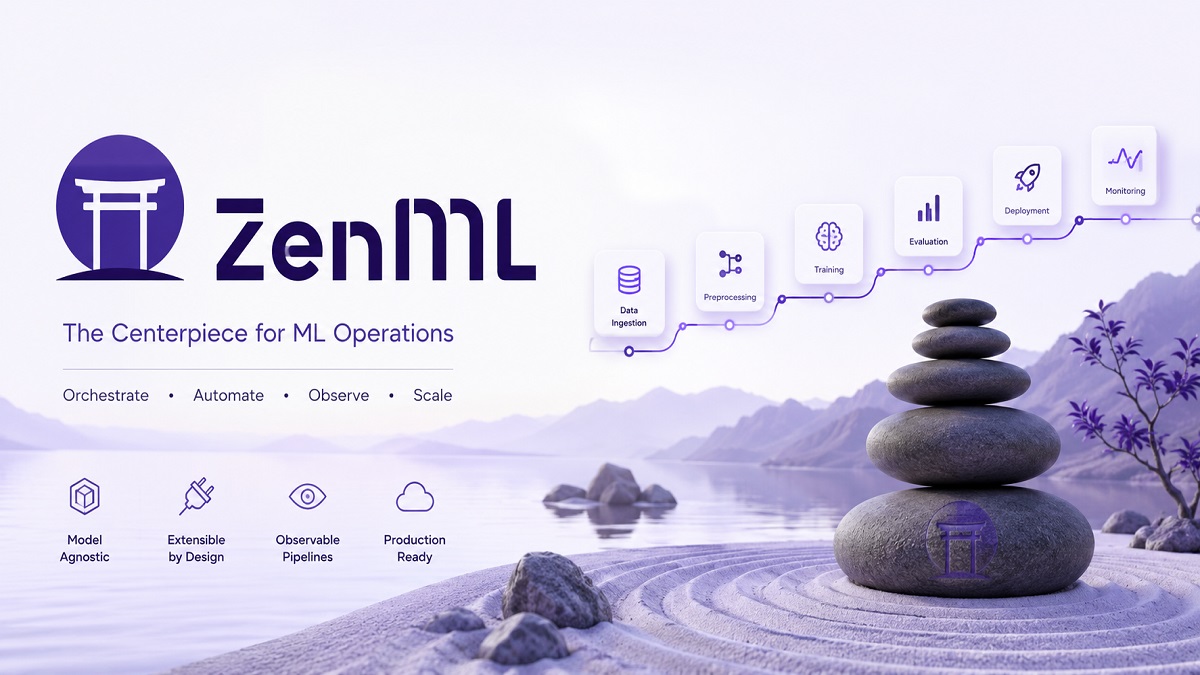
ZenML Overview
ZenML is an open-source MLOps and machine learning workflow orchestration framework designed to help teams build, manage, reproduce, and deploy ML pipelines more efficiently. It provides a structured way to connect data ingestion, preprocessing, training, evaluation, deployment, and monitoring into reusable pipeline components.
Instead of writing isolated scripts for every machine learning stage, ZenML introduces a pipeline-first approach where each step becomes modular and repeatable. This helps data scientists and ML engineers maintain cleaner projects, reduce manual work, and improve experiment tracking.
ZenML integrates with popular tools across the machine learning ecosystem including experiment tracking platforms, cloud infrastructure, orchestrators, model registries, and deployment environments. Teams can run pipelines locally during development and later scale workloads across production environments without major code changes.
Key capabilities include pipeline versioning, artifact tracking, metadata management, environment reproducibility, collaboration features, and support for modern MLOps workflows. It works well for projects ranging from small ML experiments to large production-grade machine learning systems.
ZenML is particularly useful for organizations that want to standardize ML development processes, improve reproducibility, accelerate deployment cycles, and maintain visibility across the complete machine learning lifecycle.
ZenML: Quick Verdict
ZenML is a strong choice for teams and developers who want a structured, reproducible, and scalable approach to building machine learning pipelines. Its pipeline-first architecture and broad MLOps integrations make it especially valuable for managing experiments, tracking artifacts, and moving models from development to production.
It works best for machine learning projects that require collaboration, repeatability, and deployment flexibility. While beginners may face a learning curve compared with notebook-only workflows, ZenML becomes increasingly useful as projects grow in complexity.
Overall: A powerful open-source MLOps platform for creating maintainable and production-ready ML workflows.
Pros of ZenML
- Open-source platform with flexible deployment and customization options.
- Pipeline-first workflow improves reproducibility and organization of ML projects.
- Modular architecture allows reusable pipeline steps across multiple experiments.
- Integrates with popular MLOps tools, orchestrators, cloud services, and model registries.
- Supports experiment tracking, artifact management, and metadata handling.
- Makes it easier to transition from local development to production environments.
- Encourages collaboration between data scientists, ML engineers, and operations teams.
- Helps standardize machine learning workflows and reduce manual process overhead.
- Scales well from individual projects to larger production ML systems.
- Strong focus on maintainability and repeatable machine learning pipelines.
Cons of ZenML
- Has a learning curve for beginners who are new to MLOps concepts and pipeline-based development.
- Initial setup and configuration can feel more complex than simple notebook workflows.
- Some advanced capabilities provide the most value only when integrated with additional infrastructure tools.
- Overhead may be unnecessary for very small or one-off machine learning projects.
- Debugging multi-step pipelines can require more effort compared with standalone scripts.
- Teams may need time to establish conventions and structure around pipeline design.
- Cloud deployment and orchestration setups can increase operational complexity.
- Documentation and ecosystem changes may require occasional updates to existing workflows.
- Managing multiple environments and integrations can become difficult without good project practices.
- Performance gains depend heavily on how effectively the pipeline architecture is implemented.
What is ZenML?
ZenML is an open-source MLOps (Machine Learning Operations) framework designed to simplify the development, orchestration, deployment, and management of machine learning pipelines. It provides a structured way to organize every stage of an ML workflow—including data ingestion, preprocessing, model training, evaluation, deployment, and monitoring—into reusable and reproducible pipeline steps.
Rather than relying on disconnected notebooks and scripts, ZenML helps teams build standardized workflows that can run consistently across local environments, cloud platforms, and production systems. Its modular architecture allows developers to reuse components, track artifacts, manage metadata, and maintain versioned machine learning processes.
ZenML integrates with popular tools across the MLOps ecosystem such as orchestrators, experiment trackers, model registries, cloud infrastructure, and deployment platforms. This flexibility makes it suitable for individual practitioners as well as teams building scalable and production-ready machine learning applications.
Overall, ZenML acts as a central layer that connects machine learning development with operational best practices, helping improve reproducibility, collaboration, and long-term maintainability.
ZenML Workflow
ZenML organizes machine learning development into structured, repeatable pipeline stages that move from raw data to production deployment. Each stage is defined as an independent step, allowing teams to reuse components and maintain consistency across experiments and environments.
1. Data Ingestion
The workflow begins by collecting data from sources such as databases, APIs, cloud storage, files, or streaming systems. ZenML tracks data movement to improve reproducibility.
2. Data Preparation
Raw data is cleaned, transformed, validated, and converted into a format suitable for training. These preprocessing steps become reusable pipeline components.
3. Feature Engineering
Features are generated, selected, and optimized to improve model quality while keeping transformations consistent between training and inference environments.
4. Model Training
Training pipelines execute machine learning algorithms using configured parameters and controlled environments to ensure repeatable results.
5. Evaluation and Validation
Trained models are tested against evaluation metrics to compare performance and verify readiness before deployment.
6. Artifact Tracking and Experiment Management
ZenML stores metadata, pipeline outputs, configurations, and experiment information so teams can reproduce previous runs and monitor changes.
7. Deployment
Approved models can be deployed to local infrastructure, cloud services, APIs, or production environments through integrated deployment tools.
8. Monitoring and Iteration
Once deployed, teams monitor model behavior, collect feedback, retrain when necessary, and continuously improve the pipeline lifecycle.
Key Features of ZenML
-
Pipeline-Based ML Development
Build machine learning workflows as reusable and modular pipeline steps for better structure and maintainability. -
Reproducible Experiments
Track configurations, code, artifacts, and execution history to reproduce results across environments. -
Artifact Management
Automatically manage datasets, trained models, outputs, and intermediate pipeline artifacts. -
Experiment Tracking Integration
Connect with experiment tracking tools to monitor runs, compare models, and evaluate performance over time. -
Orchestrator Support
Run pipelines locally or integrate with workflow orchestrators for scalable execution. -
Cloud and Infrastructure Flexibility
Deploy and execute workflows across local environments, cloud platforms, and production infrastructure. -
Model Deployment Workflows
Move trained models into serving environments using integrated deployment capabilities. -
Versioning and Metadata Tracking
Maintain visibility into datasets, model versions, pipeline runs, and project evolution. -
Collaborative MLOps Environment
Enable teams to share workflows and standardize machine learning processes. -
Extensible Architecture
Expand functionality through integrations and customizable pipeline components.
ZenML: Performance and Ease of Use
Performance
ZenML is designed to improve the efficiency and reliability of machine learning operations rather than accelerate raw model training speed. Its biggest performance advantage comes from structured pipelines, reusable components, artifact tracking, and automated workflow execution that reduce repetitive work and improve development consistency.
Teams can execute workflows locally during development and later scale execution through orchestration and cloud infrastructure when workloads grow. Pipeline caching and modular execution can also help avoid rerunning unchanged steps, reducing overall processing time in iterative ML development.
Performance depends on the selected infrastructure, orchestration setup, dataset size, and integrated tools. For production environments, ZenML can support more efficient and repeatable workflows compared with manually managed ML processes.
Ease of Use
ZenML offers a developer-friendly approach once the core concepts are understood, but there is an initial learning curve—especially for users who are new to MLOps, pipeline orchestration, and environment management.
The framework encourages clean project organization by breaking machine learning tasks into reusable steps. Developers familiar with Python and modern ML tooling generally adapt quickly, while larger teams benefit from improved collaboration and standardized workflows.
For small experiments or notebook-only projects, ZenML may feel more structured than necessary. However, for growing ML applications and production pipelines, the additional structure often leads to better maintainability and long-term efficiency.
Key Specifications of ZenML
-
Category:
Open-source MLOps and machine learning pipeline orchestration framework -
Primary Purpose:
Build, manage, automate, and deploy reproducible machine learning workflows -
Deployment Options:
Local environments, cloud infrastructure, and production platforms -
Pipeline Architecture:
Modular, step-based, reusable ML pipelines -
Supported Workloads:
Data ingestion, preprocessing, feature engineering, training, evaluation, deployment, and monitoring -
Programming Language:
Python-based development workflow -
Experiment Management:
Supports tracking of runs, metadata, artifacts, and reproducibility -
Integration Support:
Compatible with orchestration tools, cloud services, experiment trackers, and deployment platforms -
Scalability:
Suitable for individual projects through large-scale production ML systems -
Collaboration Features:
Shared workflows, standardized processes, and environment consistency -
Version Control Support:
Pipeline, artifact, and workflow version management -
Licensing:
Open-source with community-driven development
ZenML Pricing
ZenML offers a flexible pricing model that supports individual developers, growing ML teams, and large enterprises. Users can start with the open-source version and upgrade to managed plans when they need additional governance, collaboration, and operational features.
Open Source Free
Designed for individuals and small teams that want to self-host and manage their own infrastructure.
- Unlimited executions
- Unlimited projects
- Pipeline and workflow orchestration
- Artifact management
- Basic model registry
- Community support
Scale (Managed SaaS) Starting at $999/month
Built for production ML teams that need a managed control plane and operational features.
- Managed platform experience
- Model and artifact control plane
- Snapshots and collaboration tools
- Remote development environments
- Priority support
Enterprise Custom Pricing
Intended for organizations requiring governance, security, compliance, and large-scale deployment capabilities.
- Unlimited executions and projects
- Single Sign-On (SSO)
- Role-based access controls
- Audit logs and governance features
- Air-gapped and enterprise deployment options
- Dedicated support and SLA options
Bottom line: Most developers can begin with the free open-source edition and upgrade only when managed infrastructure, collaboration controls, or enterprise governance become necessary. Pricing and plan details may change over time, so checking the official pricing page before choosing a plan is recommended.
Who Should Use ZenML?
ZenML is designed for users and teams that want a more structured, reproducible, and scalable approach to machine learning development and operations. It is especially valuable when projects move beyond standalone notebooks and require organized workflows.
-
Machine Learning Engineers
Ideal for building production-ready ML pipelines with repeatable training, deployment, and monitoring processes. -
Data Scientists
Useful for turning experiments into reusable workflows while improving experiment tracking and reproducibility. -
MLOps Teams
Helps standardize infrastructure, automate pipeline execution, and manage the complete ML lifecycle. -
AI Product Teams
Suitable for teams developing and maintaining machine learning applications across multiple environments. -
Startups and Growing Companies
A good fit for organizations preparing to scale machine learning workloads without rebuilding workflows later. -
Research and Experimentation Projects
Beneficial for users who need versioned experiments, artifact tracking, and reproducible results. -
Cloud-Based ML Workloads
Works well for teams running machine learning pipelines across cloud infrastructure and managed environments.
ZenML may be less necessary for simple one-time models or notebook-only workflows, but it becomes increasingly valuable as collaboration, automation, and production requirements grow.
Alternatives to ZenML
| Platform | Best For | Main Strength | Potential Limitation |
|---|---|---|---|
| MLflow | Experiment tracking and model lifecycle management | Simple setup with strong experiment and model management capabilities | Less opinionated pipeline orchestration compared with ZenML |
| Kubeflow | Large-scale Kubernetes-based ML platforms | Powerful orchestration and production scalability | Higher infrastructure and operational complexity |
| Apache Airflow | General workflow orchestration with ML pipelines | Flexible scheduling and automation ecosystem | Not purpose-built specifically for machine learning workflows |
| Metaflow | Data science teams focused on usability | Developer-friendly workflow creation and cloud execution | Smaller ecosystem compared with some enterprise tools |
| Prefect | Modern workflow automation and orchestration | Clean developer experience and flexible deployment | Requires additional setup for complete MLOps capabilities |
| Dagster | Data pipelines and data platform teams | Strong observability and asset management features | Can require additional learning for advanced orchestration |
| Vertex AI Pipelines | Google Cloud machine learning environments | Managed cloud-native ML operations | Best experience is tied closely to Google Cloud infrastructure |
| Amazon SageMaker Pipelines | AWS-based machine learning teams | Integrated model development and deployment ecosystem | More platform dependency within AWS services |
ZenML vs Alternatives: Comparison
| Platform | Primary Focus | Ease of Use | Pipeline Support | Best For |
|---|---|---|---|---|
| ZenML | End-to-end MLOps and ML pipelines | Moderate learning curve | Native pipeline-first architecture | Teams building reproducible and production-ready ML workflows |
| MLflow | Experiment tracking and model management | Easy to get started | Limited orchestration compared with dedicated pipeline tools | Experiment management and model lifecycle tracking |
| Kubeflow | Kubernetes-based ML operations | Steeper learning curve | Advanced orchestration capabilities | Large-scale enterprise ML infrastructure |
| Metaflow | Developer-focused ML workflows | Beginner-friendly | Structured workflow execution | Data science and experimentation teams |
| Prefect | Workflow automation | User-friendly interface | Strong orchestration flexibility | General data and ML workflow automation |
| Dagster | Data orchestration and observability | Moderate complexity | Asset-driven orchestration | Data engineering and platform teams |
| Vertex AI Pipelines | Managed cloud ML pipelines | Easy within cloud ecosystem | Strong managed orchestration | Google Cloud machine learning deployments |
| Amazon SageMaker Pipelines | AWS machine learning lifecycle | Moderate complexity | Fully managed pipeline workflows | AWS-native production ML environments |
ZenML stands out by combining reproducibility, modular pipelines, and flexible integrations into a single MLOps workflow layer. Teams that want infrastructure flexibility often prefer ZenML, while cloud-specific solutions and orchestration platforms may be better when organizations are already committed to a particular ecosystem.
Final Verdict on ZenML
ZenML delivers a strong balance between flexibility, reproducibility, and production readiness for modern machine learning workflows. Its pipeline-first design helps transform scattered experimentation into structured and maintainable ML systems that can scale over time.
The platform performs particularly well for teams that need reusable pipelines, experiment tracking, artifact management, and deployment flexibility across local and cloud environments. Its modular architecture also makes it easier to standardize processes and improve collaboration between data scientists and ML engineers.
While there is an initial learning curve—especially for users new to MLOps concepts—the long-term benefits become more noticeable as projects grow in complexity and require repeatable execution and operational consistency.
Overall Rating: ZenML is an excellent choice for developers and organizations seeking an open, scalable, and production-oriented MLOps framework without being locked into a single infrastructure ecosystem.
Try ZenML Now