Amazon SageMaker Pipelines Review 2026
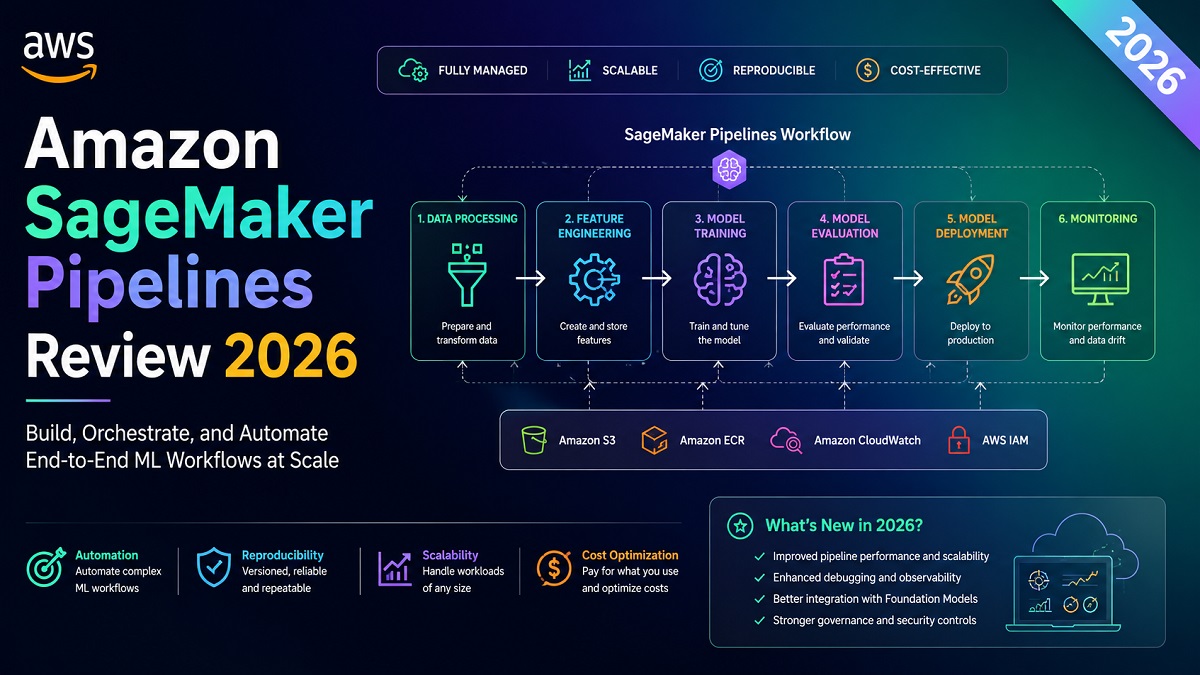
Amazon SageMaker Pipelines Overview
Amazon SageMaker Pipelines is a fully managed machine learning workflow orchestration service built within Amazon SageMaker. It helps teams automate and manage the complete ML lifecycle—from data preparation and feature engineering to model training, evaluation, approval, and deployment. By defining repeatable workflows, organizations can reduce manual work, improve consistency, and accelerate model delivery into production environments.
The platform supports building scalable ML pipelines through configurable steps, dependencies, conditional logic, and experiment tracking. Teams can trigger workflows automatically when datasets change or new code is deployed, making it easier to maintain continuous integration and continuous delivery (CI/CD) practices for machine learning projects.
SageMaker Pipelines integrates closely with other AWS services and the broader SageMaker ecosystem, allowing developers, data scientists, and MLOps teams to collaborate more efficiently. Whether managing simple training workflows or enterprise-grade machine learning operations, it provides versioning, monitoring, and governance features that help create reliable and reproducible ML processes.
Amazon SageMaker Pipelines: Quick Verdict
Amazon SageMaker Pipelines is a strong choice for teams that want to automate and standardize machine learning workflows inside the AWS ecosystem. It simplifies moving from experimentation to production by enabling repeatable pipeline stages for data processing, training, evaluation, and deployment while reducing manual operational effort.
Its biggest strengths are deep AWS integration, scalable workflow orchestration, built-in MLOps capabilities, and support for CI/CD practices. However, teams new to cloud-based machine learning or AWS services may face a learning curve during initial setup and optimization.
Overall, Amazon SageMaker Pipelines is best suited for organizations building production-grade ML systems and looking for a managed, reliable, and scalable MLOps platform.
Pros of Amazon SageMaker Pipelines
- Fully managed machine learning workflow orchestration with minimal infrastructure management.
- Automates end-to-end ML processes including data preparation, training, evaluation, and deployment.
- Deep integration with Amazon SageMaker and other AWS services for streamlined MLOps workflows.
- Supports repeatable, version-controlled pipelines for improved reproducibility and governance.
- Built-in support for CI/CD practices to accelerate model development and release cycles.
- Scales efficiently for both small projects and enterprise-grade machine learning workloads.
- Includes pipeline monitoring, experiment tracking, and execution history for better visibility.
- Conditional execution and reusable workflow components improve development efficiency.
- Helps teams collaborate more effectively across data science, engineering, and operations.
- Reduces manual intervention and lowers operational overhead for production ML systems.
Cons of Amazon SageMaker Pipelines
- Steeper learning curve for beginners unfamiliar with machine learning operations or AWS services.
- Can become expensive at scale depending on training jobs, storage, and supporting AWS resources.
- Strong dependency on the AWS ecosystem may reduce portability to other cloud platforms.
- Initial pipeline setup and configuration may require significant planning and technical expertise.
- Debugging complex multi-step workflows can take time compared to simpler ML automation tools.
- Limited appeal for small teams or lightweight machine learning projects with minimal automation needs.
- Managing permissions and IAM policies can add operational complexity.
- Pipeline customization sometimes requires additional scripting and infrastructure knowledge.
- Monitoring costs and resource optimization require ongoing attention in production environments.
- Advanced enterprise features may be underutilized by early-stage or occasional ML users.
What is Amazon SageMaker Pipelines?
Amazon SageMaker Pipelines is a fully managed machine learning workflow orchestration service that helps teams automate, organize, and scale the entire machine learning lifecycle. Built as part of Amazon SageMaker, it enables users to create structured pipelines that connect tasks such as data preparation, feature engineering, model training, evaluation, approval, and deployment into a repeatable process.
Instead of manually running ML tasks, SageMaker Pipelines allows organizations to define reusable workflow steps with dependencies and automation rules. This improves consistency, reduces operational overhead, and makes machine learning projects easier to maintain and reproduce across development and production environments.
The service is especially useful for MLOps teams and businesses that need reliable model delivery, experiment tracking, governance controls, and integration with CI/CD practices while operating within the AWS ecosystem.
Amazon SageMaker Pipelines Workflow
Amazon SageMaker Pipelines follows a structured machine learning workflow designed to automate the path from raw data to production-ready models. A typical pipeline begins with data ingestion and preprocessing, where datasets are collected, cleaned, transformed, and prepared for training. This step ensures consistent inputs and reduces manual intervention across repeated runs.
Once the data is ready, the workflow moves into model training and evaluation. Training jobs execute using defined configurations, and evaluation steps validate performance against selected metrics. Conditional logic can be applied so that only models meeting predefined quality thresholds continue to later stages of the pipeline.
After validation, approved models proceed to deployment and monitoring stages. Teams can automate model registration, release to production endpoints, and ongoing performance tracking. The entire workflow remains versioned and repeatable, helping organizations implement reliable MLOps practices and accelerate machine learning delivery.
Key Features of Amazon SageMaker Pipelines
- End-to-End ML Workflow Automation: Automates machine learning stages including data processing, training, evaluation, approval, and deployment within a single workflow.
- Reusable Pipeline Components: Build modular workflow steps that can be reused across multiple machine learning projects to improve consistency and efficiency.
- Pipeline Versioning: Track changes and maintain version history for workflows, making experiments and production deployments more reproducible.
- Conditional Execution Logic: Configure decision-based execution paths that automatically move forward only when models meet defined performance criteria.
- Integrated CI/CD Support: Enables continuous integration and continuous delivery practices for machine learning development and deployment.
- Experiment Tracking: Monitor pipeline runs, compare model outcomes, and maintain visibility across training and evaluation cycles.
- Scalable Managed Infrastructure: Runs on managed AWS infrastructure that scales according to workload requirements without manual provisioning.
- Model Registry Integration: Register, approve, organize, and manage model versions before releasing them into production environments.
- Workflow Monitoring and Visibility: Provides execution tracking, logging, and status monitoring for better operational control.
- AWS Ecosystem Connectivity: Integrates with other AWS services to support enterprise-grade MLOps and data workflows.
Amazon SageMaker Pipelines: Performance and Ease of Use
Amazon SageMaker Pipelines delivers strong performance for teams managing repeatable and production-scale machine learning workflows. Because it runs on managed AWS infrastructure, pipelines can process large datasets, execute training jobs efficiently, and scale automatically based on workload requirements. Automated execution also reduces manual bottlenecks and helps maintain consistent results across development and production environments.
From an ease-of-use perspective, SageMaker Pipelines offers visual and programmatic workflow creation through the broader SageMaker ecosystem. Teams can define pipeline stages, configure dependencies, and automate deployment processes without building custom orchestration systems from scratch. Integration with experiment tracking, model registry, and monitoring tools helps centralize ML operations.
However, usability depends on prior familiarity with AWS services and MLOps concepts. New users may encounter a learning curve when configuring permissions, pipeline logic, and cloud resources. Once configured, the platform becomes significantly easier to manage and can streamline long-term machine learning operations.
Key Specifications of Amazon SageMaker Pipelines
- Product Type: Managed machine learning workflow orchestration service
- Platform: Cloud-based (AWS)
- Primary Purpose: Automate and manage end-to-end machine learning pipelines
- Deployment Model: Fully managed service
- Workflow Support: Data preparation, training, evaluation, approval, and deployment
- Pipeline Execution: Automated and repeatable workflow runs
- Scalability: Elastic scaling through AWS infrastructure
- Version Control: Pipeline and model version tracking
- Conditional Logic: Supported for workflow branching and automated decisions
- Monitoring: Execution tracking, logging, and workflow visibility
- Model Management: Integration with model registry and lifecycle controls
- Automation Support: CI/CD and MLOps workflow integration
- API Access: Available through AWS SDKs and service APIs
- Collaboration Features: Shared workflows and centralized ML operations
- Security: IAM-based access control and AWS security services
Amazon SageMaker Pipelines Pricing
Amazon SageMaker Pipelines does not use a traditional monthly subscription or per-user pricing model. Instead, pricing follows a pay-as-you-go approach where you pay for the AWS resources consumed by your machine learning workflows.
Pay-As-You-Go Usage-Based
There is generally no separate fixed charge for creating pipelines. Costs are generated by the services and jobs executed inside the workflow, such as data processing, model training, storage, deployment, and monitoring resources.
- Training Jobs: Charged based on instance type and execution duration.
- Processing Jobs: Costs depend on compute resources and runtime.
- Storage: Charges may apply for datasets, artifacts, and model files stored in AWS services.
- Model Hosting: Endpoint and inference costs vary by usage and infrastructure.
- Monitoring & MLOps: Additional charges may apply for related monitoring and lifecycle services.
For small experiments, costs can remain modest, but large-scale production pipelines may become significantly more expensive depending on execution frequency and infrastructure choices. Reviewing AWS pricing calculators and enabling cost monitoring is recommended before scaling workloads.
Who Should Use Amazon SageMaker Pipelines?
Amazon SageMaker Pipelines is designed for users and organizations that need automated, scalable, and production-ready machine learning workflows within the AWS ecosystem.
- MLOps Teams: Ideal for teams building repeatable workflows, automating model delivery, and managing machine learning operations at scale.
- Data Scientists: Useful for reducing manual pipeline execution and improving experiment reproducibility across projects.
- Machine Learning Engineers: Suitable for creating structured training, evaluation, and deployment processes with automation.
- Enterprise Organizations: A strong fit for businesses requiring governance, monitoring, version control, and collaboration across ML teams.
- AWS-Centric Development Teams: Best for organizations already using AWS services and looking for deeper integration across infrastructure and workflows.
- Teams Adopting CI/CD for ML: Helpful for implementing continuous integration and continuous delivery practices for machine learning applications.
- Large-Scale ML Projects: Well suited for projects that process large datasets and require reliable production deployment pipelines.
It may be less suitable for individuals, very small teams, or projects that only require occasional model training without automation needs.
Alternatives to Amazon SageMaker Pipelines
| Platform | Best For | Key Strength |
|---|---|---|
| ZenML | Flexible MLOps workflows | Open-source pipeline orchestration with multi-cloud support |
| Kubeflow Pipelines | Kubernetes-based ML environments | Highly customizable machine learning workflow automation |
| MLflow | Experiment tracking and model lifecycle management | Strong reproducibility and model management capabilities |
| Google Vertex AI Pipelines | Teams operating in Google Cloud | Managed ML orchestration with tight cloud integration |
| Azure Machine Learning Pipelines | Enterprise ML on Microsoft Azure | Integrated MLOps and deployment workflows |
| Apache Airflow | General workflow orchestration | Flexible DAG-based automation across data and ML tasks |
| Dataiku | Collaborative analytics and ML teams | Visual workflow design and enterprise governance features |
| Metaflow | Data science teams seeking simplicity | Developer-friendly workflow management for ML projects |
Amazon SageMaker Pipelines remains a strong choice for AWS-first organizations, but teams prioritizing open-source flexibility, multi-cloud portability, or simpler deployment experiences may find these alternatives better aligned with their workflow requirements.
Amazon SageMaker Pipelines vs Alternatives: Comparison
| Platform | Deployment Model | Best For | Main Advantage | Potential Limitation |
|---|---|---|---|---|
| Amazon SageMaker Pipelines | Managed Cloud Service | Production ML workflows on AWS | Deep AWS integration and managed MLOps automation | Strong dependence on the AWS ecosystem |
| ZenML | Open Source / Multi-Cloud | Portable ML pipelines | Flexible orchestration across different environments | Requires more setup and infrastructure management |
| Kubeflow Pipelines | Self-Hosted / Kubernetes | Large-scale Kubernetes deployments | High customization and extensibility | Higher operational complexity |
| MLflow | Open Source / Managed Options | Experiment tracking and model lifecycle | Strong model management and reproducibility | Less focused on complete workflow orchestration |
| Google Vertex AI Pipelines | Managed Cloud Service | Google Cloud ML operations | Integrated cloud-native ML workflows | Best experience tied to Google Cloud services |
| Azure Machine Learning Pipelines | Managed Cloud Service | Enterprise Azure environments | Integrated deployment and governance tools | Can become complex for smaller teams |
| Apache Airflow | Self-Hosted / Managed | General workflow automation | Broad workflow orchestration flexibility | Requires additional ML tooling integration |
Amazon SageMaker Pipelines stands out for organizations already invested in AWS and seeking managed MLOps capabilities. Alternatives may offer greater portability, open-source flexibility, or cloud-specific advantages depending on infrastructure preferences and operational requirements.
Final Verdict on Amazon SageMaker Pipelines
Amazon SageMaker Pipelines is a powerful managed MLOps solution for teams that need structured, automated, and scalable machine learning workflows. By bringing together data preparation, model training, evaluation, approval, and deployment into a unified system, it helps organizations reduce operational overhead and improve consistency across the ML lifecycle.
Its biggest advantages are deep integration with AWS services, built-in workflow automation, version control, and support for production-ready CI/CD practices. These capabilities make it especially attractive for machine learning engineers, data science teams, and enterprises operating at scale.
The platform does require some familiarity with AWS concepts and may feel more complex than lightweight alternatives for smaller projects. However, for organizations committed to AWS and looking to establish reliable MLOps processes, Amazon SageMaker Pipelines remains one of the strongest managed workflow orchestration options available.
Try Amazon SageMaker Pipelines Now