Apache Airflow Review 2026
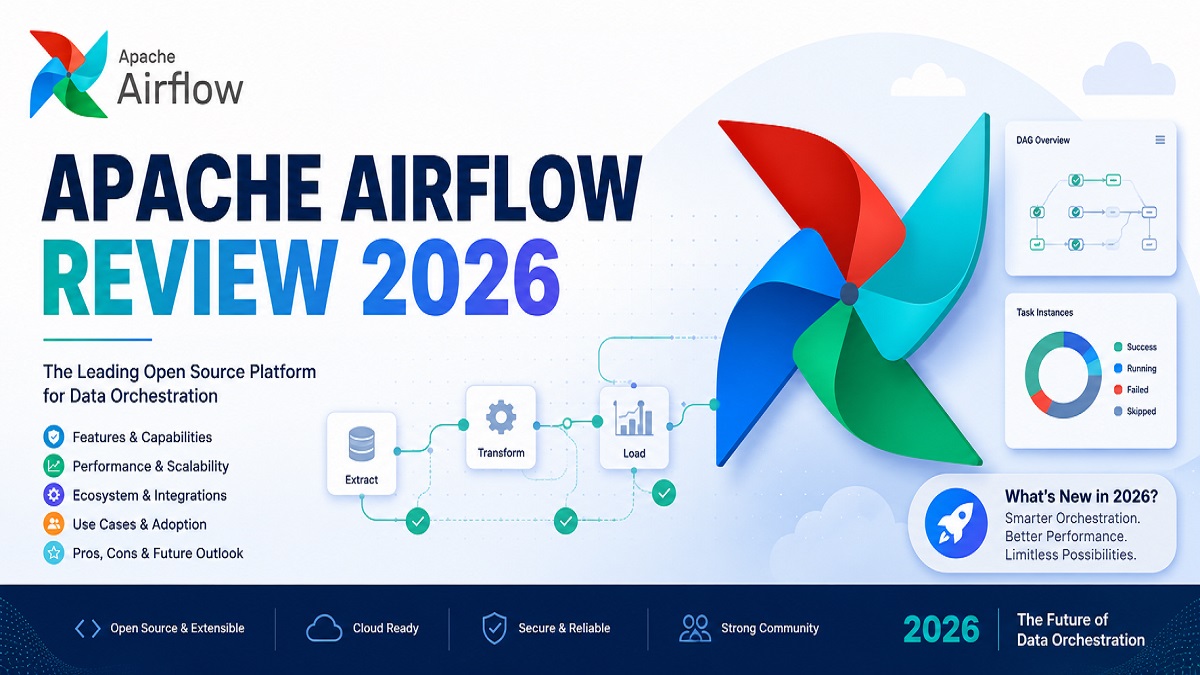
Apache Airflow Overview
Apache Airflow is a popular open-source workflow orchestration platform designed to create, schedule, monitor, and manage complex data pipelines. Originally developed at Airbnb and now maintained by the Apache Software Foundation, Airflow enables developers and data engineers to define workflows as Python code, making pipeline creation flexible, version-controlled, and easy to maintain. It has become one of the industry's standard tools for automating ETL processes, machine learning workflows, data integration, analytics jobs, and cloud infrastructure tasks.
Airflow organizes workflows as Directed Acyclic Graphs (DAGs), where each task represents a unit of work and dependencies determine execution order. Its rich web interface provides real-time monitoring, task logs, scheduling history, retries, alerts, and workflow visualization. With extensive integrations for cloud platforms, databases, Kubernetes, Spark, Docker, AWS, Google Cloud, Microsoft Azure, and hundreds of third-party services, Apache Airflow is suitable for organizations ranging from small startups to large enterprises that need reliable workflow automation.
Because workflows are written in Python, Airflow offers exceptional flexibility compared to drag-and-drop workflow builders. Developers can reuse code, implement custom operators, and integrate virtually any API or service. While beginners may face a learning curve due to its architecture and deployment requirements, Airflow remains one of the most powerful orchestration platforms available for modern data engineering, DevOps automation, and machine learning operations.
Apache Airflow: Quick Verdict
Apache Airflow is one of the most capable workflow orchestration platforms available for data engineering, ETL automation, and MLOps. Its Python-based workflow definitions, powerful scheduling engine, extensive integrations, and active open-source community make it an excellent choice for organizations that need reliable and scalable pipeline automation. The platform excels at managing complex dependencies, monitoring workflow execution, and integrating with modern cloud services.
Although Airflow offers exceptional flexibility, it requires some technical expertise to deploy, configure, and maintain. It is best suited for developers, DevOps engineers, and data teams rather than non-technical users looking for a no-code solution. Overall, Apache Airflow earns a 4.8/5 rating thanks to its robust feature set, scalability, and widespread industry adoption.
Pros of Apache Airflow
- Free and open-source with no licensing costs.
- Workflows are defined in Python, offering maximum flexibility and version control.
- Powerful scheduling engine supports complex dependencies and recurring tasks.
- Excellent web interface for monitoring, logging, retries, and workflow visualization.
- Highly scalable using distributed executors such as Celery and Kubernetes.
- Extensive integrations with AWS, Google Cloud, Azure, Docker, Spark, Kubernetes, Snowflake, Databricks, and hundreds of other services.
- Large open-source community with frequent updates, plugins, and comprehensive documentation.
- Supports dynamic workflow generation and reusable pipeline components.
- Built-in alerting, task retries, SLA monitoring, and error handling improve reliability.
- Widely adopted across enterprises for ETL, data engineering, MLOps, and DevOps automation.
Cons of Apache Airflow
- Steep learning curve for beginners unfamiliar with workflow orchestration.
- Initial setup and deployment can be complex, especially for production environments.
- Requires ongoing infrastructure management unless using a managed Airflow service.
- The user interface is functional but less intuitive than some modern commercial platforms.
- Not designed for real-time or event-driven streaming workflows with ultra-low latency.
- Resource consumption can be high for large-scale deployments with many concurrent tasks.
- Debugging complex DAGs and dependency issues can be time-consuming.
- Performance tuning often requires knowledge of executors, schedulers, and metadata databases.
- Limited built-in role-based access control compared to some enterprise orchestration platforms.
- Non-technical users may find Python-based workflow creation challenging.
What is Apache Airflow?
Apache Airflow is an open-source workflow orchestration platform used to author, schedule, monitor, and automate complex workflows and data pipelines. It enables developers and data engineers to define workflows as Python code using Directed Acyclic Graphs (DAGs), where each task represents a step in a process and dependencies determine the order of execution. Originally developed at Airbnb and now maintained by the Apache Software Foundation, Airflow has become one of the most widely adopted orchestration tools for ETL, data engineering, machine learning, and DevOps automation.
Apache Airflow provides a powerful scheduler, a web-based interface for monitoring workflow execution, detailed task logs, automatic retries, alerting, and extensive integration with cloud services, databases, container platforms, and third-party applications. Its flexibility, scalability, and rich ecosystem of operators make it suitable for organizations of all sizes that need to automate recurring or complex workflows across modern data and cloud environments.
Apache Airflow Workflow
Apache Airflow organizes automation using Directed Acyclic Graphs (DAGs), where each workflow is defined as Python code. A DAG contains multiple tasks connected by dependencies, ensuring each task runs in the correct sequence without creating circular loops. The Airflow Scheduler continuously scans for new DAGs, determines when they should run based on schedules or triggers, and places eligible tasks into an execution queue.
Once tasks are queued, an Executor (such as LocalExecutor, CeleryExecutor, or KubernetesExecutor) distributes them to one or more worker processes. Each worker executes the assigned task, whether it's extracting data from a database, transforming files, training a machine learning model, or triggering cloud services. Throughout execution, Airflow records task status, execution time, logs, retries, and metadata in its backend database.
The built-in web interface allows users to visualize DAGs, monitor task progress, inspect logs, manually trigger workflows, retry failed tasks, and receive alerts when problems occur. Because workflows are written entirely in Python, teams can easily customize task logic, integrate external APIs, and version-control pipelines alongside their application code, making Apache Airflow a highly flexible orchestration platform for modern data engineering and automation.
Key Features of Apache Airflow
- Python-Based Workflow Authoring: Define workflows as Python code using Directed Acyclic Graphs (DAGs), enabling version control, code reuse, and flexible pipeline development.
- Advanced Workflow Scheduling: Schedule workflows using cron expressions, time intervals, event triggers, or custom timetables to automate recurring tasks.
- Directed Acyclic Graphs (DAGs): Model complex task dependencies and execution order while ensuring workflows remain efficient and free of circular dependencies.
- Rich Web Interface: Monitor workflows, visualize DAGs, inspect task logs, retry failed jobs, and manage pipeline execution through an intuitive dashboard.
- Extensive Integrations: Connect with hundreds of services including AWS, Google Cloud, Microsoft Azure, Docker, Kubernetes, Apache Spark, Snowflake, Databricks, SQL databases, and REST APIs.
- Scalable Execution: Support LocalExecutor, CeleryExecutor, and KubernetesExecutor for everything from single-server deployments to large distributed environments.
- Automatic Retries & Alerts: Configure retries, timeout policies, SLA monitoring, email notifications, and custom alerting for improved workflow reliability.
- Dynamic Workflow Generation: Build parameterized and dynamically generated DAGs to simplify large-scale workflow management.
- Task Logging & Monitoring: Access detailed execution logs, task history, runtime metrics, and troubleshooting information directly from the web interface.
- Role-Based Access Control (RBAC): Manage user authentication and permissions to secure workflow access across teams.
- Plugin & Custom Operator Support: Extend Airflow by creating custom operators, sensors, hooks, executors, and plugins tailored to your organization's needs.
- Open-Source Ecosystem: Benefit from a large community, regular updates, comprehensive documentation, and a vast library of provider packages.
Apache Airflow: Performance and Ease of Use
Apache Airflow delivers excellent performance for scheduling and orchestrating complex workflows, particularly in data engineering, ETL pipelines, MLOps, and cloud automation. Its modular architecture allows organizations to scale from a single machine to large distributed clusters using executors such as LocalExecutor, CeleryExecutor, and KubernetesExecutor. The scheduler efficiently manages thousands of tasks, while built-in retries, task queues, and dependency management help ensure reliable workflow execution even in enterprise-scale environments.
In terms of usability, Airflow is designed primarily for developers and data engineers rather than non-technical users. Workflows are written entirely in Python, offering unmatched flexibility but requiring programming knowledge. The web interface is clean and informative, making it easy to monitor DAGs, inspect logs, trigger workflows manually, and troubleshoot failures. However, initial installation, configuration, and production deployment can be challenging for beginners, especially when configuring executors, metadata databases, and distributed workers.
Once deployed, Apache Airflow is highly reliable and maintainable, with extensive documentation, an active open-source community, and hundreds of provider packages that simplify integration with cloud platforms, databases, and third-party services. While it has a steeper learning curve than many low-code workflow tools, its scalability, customization capabilities, and mature ecosystem make it one of the best orchestration platforms available for professional data and infrastructure automation.
Key Specifications of Apache Airflow
- Tool Name: Apache Airflow
- Developer: Apache Software Foundation
- Initial Release: 2015
- License: Apache License 2.0 (Open Source)
- Primary Purpose: Workflow orchestration, task scheduling, and data pipeline automation
- Workflow Model: Python-based Directed Acyclic Graphs (DAGs)
- Programming Language: Python
- Deployment Options: Self-hosted, Docker, Kubernetes, Virtual Machines, Managed Cloud Services
- Supported Executors: SequentialExecutor, LocalExecutor, CeleryExecutor, KubernetesExecutor, CeleryKubernetesExecutor
- Operating Systems: Linux, macOS, Windows (development), Docker containers
- Cloud Integrations: AWS, Google Cloud Platform, Microsoft Azure, Oracle Cloud, IBM Cloud, and more
- Database Support: PostgreSQL, MySQL, SQLite (development only), Microsoft SQL Server
- Container Support: Docker and Kubernetes
- Monitoring: Web UI, task logs, metrics, alerts, SLA monitoring, and audit history
- Authentication: Basic Auth, LDAP, OAuth, OpenID Connect (OIDC), and other enterprise authentication methods
- Role-Based Access Control (RBAC): Yes
- Scheduling: Cron expressions, intervals, custom timetables, manual triggers, and event-based scheduling
- API Support: REST API and Python APIs
- Version Control: Git-friendly because workflows are stored as Python code
- Scalability: Suitable for single-server deployments to enterprise-scale distributed clusters
- Best For: ETL pipelines, data engineering, MLOps, analytics workflows, DevOps automation, and workflow orchestration
- Pricing: Free and open-source (infrastructure and managed cloud services may incur costs)
Apache Airflow Pricing
Apache Airflow is completely free and open-source software released under the Apache License 2.0. There are no licensing fees, subscription plans, or per-user charges to download, deploy, or use the platform. However, organizations should consider the costs of the infrastructure required to run Airflow, such as virtual machines, Kubernetes clusters, databases, storage, and monitoring services.
Open-Source Edition Free
- No software licensing or subscription costs.
- Unlimited workflows (DAGs), tasks, and users.
- Access to the complete source code and all core features.
- Large ecosystem of community-maintained providers and plugins.
- Community documentation and support through forums and GitHub.
Infrastructure Costs Varies
Self-hosted deployments require resources such as compute instances, metadata databases (typically PostgreSQL or MySQL), storage, networking, and monitoring tools. Costs depend on workload size, task concurrency, and the underlying cloud or on-premises infrastructure.
Managed Apache Airflow Services Pay-as-you-go
Organizations that prefer not to manage their own infrastructure can choose managed Airflow offerings from cloud providers. Pricing varies based on compute resources, storage, scheduler capacity, worker nodes, and usage. Popular managed services include:
- Amazon Managed Workflows for Apache Airflow (MWAA)
- Google Cloud Composer
- Azure Managed Airflow solutions (via partners)
- Astronomer
Overall, Apache Airflow offers exceptional value because the software itself is free. Users only pay for the infrastructure or managed cloud service required to run their workflows, making it a cost-effective choice for organizations of all sizes.
Who Should Use Apache Airflow?
Apache Airflow is designed for organizations and technical teams that need to automate, schedule, and monitor complex workflows. Its Python-based architecture and extensive integration ecosystem make it particularly well suited for data engineering, cloud automation, and machine learning operations. While it offers exceptional flexibility and scalability, it is best suited for users with programming and infrastructure experience.
- Data Engineers: Build, schedule, and monitor ETL and ELT pipelines that move and transform data across multiple systems.
- Machine Learning Engineers: Automate model training, validation, deployment, and retraining workflows as part of MLOps pipelines.
- DevOps Engineers: Orchestrate infrastructure automation, backups, deployments, maintenance tasks, and cloud operations.
- Data Scientists: Schedule recurring data preparation, feature engineering, reporting, and analytics workflows.
- Cloud Engineers: Manage workflows across AWS, Google Cloud, Azure, Kubernetes, Docker, and hybrid cloud environments.
- Enterprise IT Teams: Coordinate business-critical workflows that require monitoring, logging, retries, alerts, and dependency management.
- Software Development Teams: Integrate automated testing, deployment pipelines, and scheduled application maintenance tasks into development workflows.
- Organizations with Large-Scale Data Pipelines: Handle thousands of scheduled tasks while maintaining reliability and scalability across distributed environments.
Not ideal for: Non-technical users, small teams seeking a no-code workflow builder, or organizations that need ultra-low-latency, real-time event processing rather than scheduled workflow orchestration.
Alternatives to Apache Airflow
| Tool | Best For | Open Source | Deployment | Key Advantage |
|---|---|---|---|---|
| Prefect | Modern workflow orchestration | Yes | Cloud & Self-hosted | Developer-friendly interface with simpler deployment |
| Dagster | Data engineering and data quality | Yes | Cloud & Self-hosted | Strong asset-based data orchestration and testing |
| Luigi | ETL pipelines and batch processing | Yes | Self-hosted | Lightweight workflow management with simple scheduling |
| Argo Workflows | Kubernetes-native workflows | Yes | Kubernetes | Excellent for containerized and cloud-native applications |
| Kubeflow Pipelines | Machine learning workflows | Yes | Kubernetes | Purpose-built for MLOps and ML pipeline automation |
| Azure Data Factory | Cloud data integration | No | Microsoft Azure | Low-code data pipeline creation with Azure integration |
| AWS Step Functions | Serverless workflow orchestration | No | AWS Cloud | Deep integration with AWS serverless services |
| Google Cloud Composer | Managed Apache Airflow | No | Google Cloud | Fully managed Airflow without infrastructure management |
| Astronomer | Enterprise Apache Airflow | No | Cloud & Self-hosted | Enterprise-grade managed Airflow platform with enhanced tooling |
| Kestra | Workflow automation and orchestration | Yes | Cloud & Self-hosted | Modern UI, YAML-based workflows, and event-driven automation |
Apache Airflow vs Alternatives: Comparison
| Feature | Apache Airflow | Prefect | Dagster | Argo Workflows | AWS Step Functions |
|---|---|---|---|---|---|
| License | Open Source | Open Source | Open Source | Open Source | Commercial |
| Workflow Definition | Python (DAGs) | Python | Python (Assets & Jobs) | YAML | JSON |
| Best For | ETL, Data Engineering, MLOps | Modern Data Pipelines | Data Platform Engineering | Kubernetes Automation | AWS Serverless Workflows |
| Deployment | Self-hosted & Managed Cloud | Cloud & Self-hosted | Cloud & Self-hosted | Kubernetes | AWS Cloud Only |
| Ease of Setup | Moderate to Difficult | Easy | Moderate | Moderate | Easy |
| Scalability | Excellent | Excellent | Excellent | Excellent | Excellent |
| Web Interface | Comprehensive | Modern | Modern | Basic | AWS Console |
| Cloud Integrations | Extensive | Extensive | Extensive | Kubernetes-focused | AWS Services Only |
| Learning Curve | High | Low to Moderate | Moderate | High | Low |
| Pricing | Free (Infrastructure Costs Apply) | Free & Paid Cloud Plans | Free & Paid Cloud Plans | Free | Pay-as-you-go |
| Ideal Users | Data Engineers, DevOps, MLOps Teams | Developers, Data Teams | Data Engineers & Analytics Teams | Cloud-Native DevOps Teams | AWS-Centric Organizations |
Overall: Apache Airflow remains one of the most mature and feature-rich workflow orchestration platforms for enterprise data pipelines. Prefect offers a more developer-friendly experience, Dagster focuses on modern data engineering and asset management, Argo Workflows excels in Kubernetes-native environments, and AWS Step Functions is the best choice for organizations building serverless applications entirely within the AWS ecosystem.
Final Verdict on Apache Airflow
Apache Airflow is one of the most powerful and widely adopted workflow orchestration platforms available today. Its Python-based DAG architecture, enterprise-grade scheduling capabilities, extensive integration ecosystem, and highly scalable execution model make it an outstanding choice for automating ETL pipelines, machine learning workflows, cloud operations, and complex business processes. As an open-source project backed by the Apache Software Foundation, it also benefits from a large community, regular updates, and excellent documentation.
Although Airflow has a steeper learning curve than many modern low-code workflow tools, its flexibility and customization capabilities far outweigh the initial complexity for technical teams. Organizations willing to invest time in deployment and configuration gain a reliable, production-ready platform capable of orchestrating thousands of workflows across distributed environments. Managed services such as Amazon MWAA, Google Cloud Composer, and Astronomer further simplify deployment for teams that prefer a fully managed experience.
Overall, Apache Airflow is an excellent investment for data engineers, DevOps professionals, machine learning teams, and enterprises seeking a robust workflow orchestration solution. Its mature ecosystem, scalability, and open-source licensing continue to make it one of the industry standards for workflow automation.
Overall Rating:
Try Apache Airflow Now